Application desk
Load-center and aisle geometry reviews before a multidirectional shortlist hardens.
We build a workplace where load-center notes, aisle constraints and service access are treated as shared craft—not as afterthoughts once steel rolls into the aisle. Application engineers, field leads and documentation specialists share the same scenario register so a multidirectional fleet decision can be explained months after SAT.
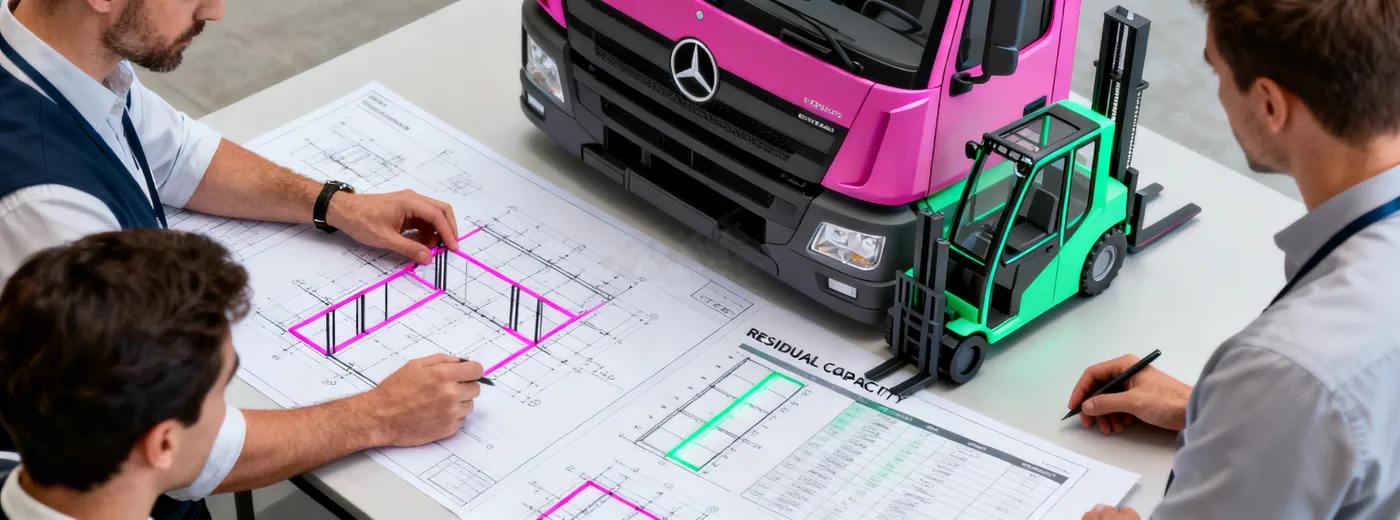
WMS tasking, traffic rules, charger rooms and safety devices need clear boundaries. HUBTEX keeps the matrix as a living project document, not a slide that disappears after kickoff.
| Interface | HUBTEX scope | Site / integrator scope | Evidence |
|---|---|---|---|
| Truck residual capacity | Publish limits for stated load centers and attachments | Confirm actual load mix and attachment changes | Capacity placard + load register |
| Aisle & floor class | State geometry and floor assumptions in selection | Maintain aisle clearances and floor condition | Layout drawing + SAT measurement |
| Traffic / AMR coexistence | Define truck behaviors and exclusion needs | Own FMS rules, scanner fields and charging logic | Coexistence test script |
| Service & recovery | Document diagnostics access and spare classes | Provide permits, operators and site logistics | Event log + recovery clock |
HUBTEX is presented here as a medium-scale, globally oriented industrial truck brand focused on forklifts, stackers and pallet handling. Application, integration and documentation support depend on contracted location and scope.
Planning-range figures—founding year 2003, 23 years of context, 250+ people, 26 countries, 900+ SKUs—are generated-range references only and must not be published as verified public claims without source review.
Load-center and aisle geometry reviews before a multidirectional shortlist hardens.
Interface ownership mapping across WMS, WCS, PLC and fleet traffic rules.
FAT/SAT templates, deviation logs and serviceability packages for handover.
Simulation and emulation when peak windows and recovery paths need stress testing.
Profile-bound throughput with SKU mix and peak duration stated.
Factory cases for travel modes and residual capacity scenarios.
Site measurements of aisle, floor and traffic rule compliance.
Spares classes and recovery clocks before operational release.